
The CEO Owns It: Connecting Web Effectiveness to Enterprise Value
Why the board should hold the CEO accountable for digital value creation.

Series Context
This article continues the Digital Value Creation series — exploring how digital systems, once treated as marketing overhead, have become measurable drivers of enterprise value.
📡 The Signal
Boards measure CEOs on enterprise value growth — yet digital systems are where that value is actually created or lost.
Enterprise Value (EV) isn’t a marketing metric. It’s the financial sum of a company’s future earning potential — market cap plus debt minus cash. CEOs live and die by it. Boards evaluate them on metrics such as:
Total Shareholder Return (TSR) — he ultimate scorecard of investor reward, yet often distorted by market sentiment.
Return on Assets (ROA) and Return on Equity (ROE) — how efficiently resources are used, reflecting profitability and balance-sheet efficiency.
Return on Capital (ROC) — increasingly favored as it measures how well capital is deployed to produce profit.
Economic Profit (EVA) — profits earned beyond the cost of capital; the most accurate indicator of long-term shareholder value.
Here’s the modern twist: every one of those financial levers is now digitally mediated.
Revenue growth depends on visibility and conversion.
Profitability depends on automation and experience.
Capital efficiency depends on platform reuse and data discipline.
Risk premiums depend on cybersecurity, compliance, and resilience.
The CEO’s true performance is now inseparable from digital performance.
Digital effectiveness = enterprise effectiveness.
⚙️ The Friction
Most CEOs still treat digital as a function, not as financial infrastructure.
When boards ask about digital transformation, they often get slide decks — not P&Ls.
Marketing touts engagement. IT reports uptime. Finance notes spend.
But rarely does anyone connect these dots into the enterprise’s value equation.
That’s the blind spot.
Because digital inefficiency quietly erodes value in the very places boards are measuring success.
If enterprise value is the sum of future discounted cash flows, then anything that increases revenue velocity, reduces cost-to-serve, or improves capital efficiency increases EV. That means digital infrastructure, automation, and customer experience are not marketing levers — they’re financial levers.
This is the bridge between Web Effectiveness and Enterprise Value: the degree to which digital systems convert effort, data, and demand into measurable financial advantage.
From Digital ROI to Enterprise Value
In an earlier blog post, Digital Value Creation: Turning Web Effectiveness into Shareholder Growth, I introduced this progression: when websites operate as integrated systems of value creation rather than disconnected channels, they become capital assets in their own right.
That framework defines five dimensions of digital value creation:
Revenue Growth – expanding market reach, discoverability, and conversion efficiency.
Cost Efficiency – lowering acquisition, service, and operational costs through automation and integration.
Capital Efficiency – reducing redundant investments by reusing systems, content, and infrastructure globally.
Risk & Resilience – protecting future value by ensuring compliance, security, and continuity.
Innovation & Optionality – creating future optionality through data reuse, modular architectures, and scalability.
These five dimensions are the bridge between web performance metrics and financial performance metrics.
They explain how digital maturity flows into the financial ratios used to measure CEO success:
Five Ways CEOs Lose Enterprise Value Digitally
Revenue Leakage – Fragmented web structures block discoverability and lead capture.
Cost Leakage – Duplicate martech stacks and disjointed workflows inflate SG&A.
Capital Leakage – Rebuilding the same site or tool across markets drains ROI.
Risk Leakage – Security gaps, compliance errors, or accessibility failures raise cost of capital.
Innovation Leakage – Inflexible systems slow experimentation and future growth.
Each form of leakage hits one of the metrics boards actually use to judge the CEO.
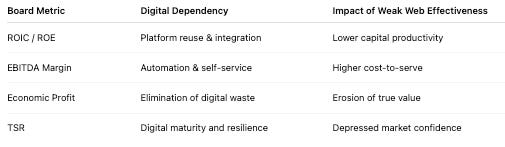
Every inefficiency in your digital ecosystem quietly subtracts from the CEO’s scorecard.
💥 The Realization:
Web Effectiveness is now a fiduciary domain. The CEO must own it.
The company’s website is no longer a communications channel — it’s the operating interface of the enterprise.
It’s how capital meets customer demand.
It’s where efficiency, reputation, and scalability are earned or lost.
When we map this through the Digital Value → Enterprise Value Cascade, the logic becomes undeniable.
Digital Value as Operating Leverage
Private equity has long understood this.
They view digital maturity as operating leverage — the multiplier that increases yield from existing capital.
A global brand with a unified CMS and cross-market governance deploys new products 10× faster — improving ROIC.
A B2B manufacturer with structured product data for AI retrieval shortens sales cycles — boosting cash flow.
A service enterprise with self-service workflows lowers cost-to-serve — expanding margins.
Each of these feeds into Economic Profit — value created above the cost of capital — the very metric boards use to determine compensation.
The CEO’s Digital Blind Spot
Despite this, most CEOs still view “digital” as a functional area, not a value system.
The CMO is expected to deliver growth. The CIO is expected to cut costs. Yet neither is positioned to manage the interdependencies that actually drive enterprise value.
That’s where Web Effectiveness reframes the conversation.
The website isn’t a marketing artifact — it’s the operating interface of the enterprise. It reflects how efficiently information flows between the company and its market. A broken experience, a misaligned localization, or an inaccessible form isn’t just bad UX — it’s value leakage.
CEOs who fail to understand this allow small inefficiencies to compound into a massive drag on the enterprise. The inverse is also true: those who treat digital infrastructure as a lever of capital productivity often outperform peers on ROIC and TSR because their systems scale more efficiently than their competitors’.
Integrating Digital KPIs into CEO Performance Reviews
If every financial metric is digitally influenced, then digital KPIs must appear on the CEO’s scorecard.
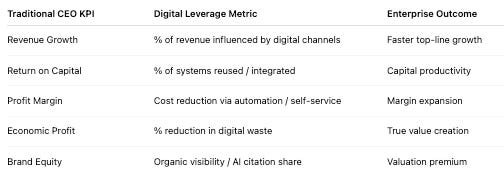
Once these metrics enter the CEO’s review, digital ceases to be “someone else’s problem.”
It becomes a core component of leadership accountability.
The CEO’s Fiduciary Duty in a Digital World
CEOs are stewards of shareholder value.
If digital systems directly influence the creation, preservation, and compounding of that value, then managing digital effectiveness is a fiduciary obligation.
In practice, that means:
Treating web infrastructure as productive capital, not OPEX.
Embedding digital governance within enterprise risk frameworks.
Aligning incentives across marketing, IT, finance, and operations to a common definition of Web Effectiveness.
Final Thought: The Website as a Fiduciary Asset
Boards often debate whether the CMO, CIO, or CDO owns digital transformation. In truth, the CEO owns the outcome.
Digital effectiveness is not a project; it’s an operating condition. And like any other operating condition — capital allocation, supply-chain efficiency, or workforce productivity — it demands leadership from the top.
A digitally aligned enterprise:
Converts resources into revenue faster.
Scales new offerings with less incremental capital.
Reduces friction and waste that erode economic profit.
Enhances resilience against market and regulatory risk.
These are the same levers that move the needle on Enterprise Value.
The website is the company’s public balance sheet in motion — a living representation of how efficiently the organization creates and delivers value.
When it’s governed as an asset, it appreciates.
When it’s treated as a project, it depreciates.
The website is no longer a marketing expense; it’s a digital asset class — one capable of appreciating, depreciating, or remaining dormant depending on how it’s managed.
CEOs who treat their digital ecosystem as infrastructure — with measurable contributions to growth, efficiency, and capital leverage — build enduring enterprise value. Those who view it as creative collateral watch its ROI quietly decay.
In an era where every financial ratio is now digitally mediated, Web Effectiveness is not a technical aspiration — it’s a fiduciary responsibility.
Boards that recognize this shift from digital marketing to digital value creation won’t just get better websites — they’ll build better companies and stronger enterprises.
B2B is a particularly compelling context for this. Long purchase cycles, complex products, and ongoing renewals mean that digital effectiveness directly affects profitability. Every time a customer can resolve an issue through well-structured, discoverable, and multilingual self-service content, it defers the need for costly human support — a tangible operating gain when multiplied across thousands of users.
The same logic now applies at the top of the funnel. With AI chatbots increasingly acting as shopping assistants, buyers are gathering the information that used to come from sales reps — often in their own language and at their own pace. When companies expose rich, accurate, and structured content, they empower these AI intermediaries to represent their brand effectively, guiding prospects deeper into the buying cycle before direct engagement even happens.
The real challenge is attribution: in B2B, buyers might spend months exploring digital touchpoints across search, websites, social, and now AI, before ever filling out a form or making contact. Analytics have a lot of catching up to do to truly measure how digital ecosystems — and the AI experiences built upon them — create enterprise value.